



Contact Us
| Frequently Asked Questions and Answers on Solar Photovoltaic
Q: Why do I need to install solar photovoltaics?
A : (1) Sell the electricity to Taipower and turn the roof into a stable income generating tool.
(2) Solar panels insulate the roof from the sun's rays, effectively reducing the indoor temperature by 3-5 degrees.
(3) Protect the roof and have a legal and beautiful solar canopy.
(4) Green energy helps to reduce carbon emissions and protects Taiwan and the planet.
Q: What are the conditions for applying to RE100?
A : As of August 2025, RE100 has over 400 global members, including 38 in Taiwan. To join, a company must have annual electricity consumption of at least 100 GWh (0.1 TWh), publicly commit to achieving 100% renewable electricity no later than 2050, and report its progress annually.
SPE is the first energy service provider in Taiwan to assist small and medium-sized enterprises in joining RE100, and has successfully assisted three companies in becoming RE100 members.
If you have questions about joining RE100, feel free to contact us to plan your company’s renewable energy transition.
Q : Are there any government subsidies for installing solar power systems now?
A: In order to encourage the installation of solar power generation systems, the Ministry of Economic Affairs, in accordance with Article 9 of the Renewable Energy Development Ordinance, reviews and determines the billing rates for various types of renewable energy power each year, and offers preferential fixed prices and long-term guarantees for the acquisition of renewable energy power produced by the industry and the public.
◆ The 2025 solar photovoltaic feed-in tariffs are detailed in the table below:

Note: For relevant information, please refer to the latest renewable energy feed-in tariffs announced by the Bureau of Energy.
Q: Will Taipower guarantee to buy my solar power at a fixed rate for 20 years?
A : Yes! Under the government’s feed-in tariff scheme, Taipower will sign a 20-year purchase agreement at the fixed rate announced in your application year.
This ensures stable income for 20 years, free from electricity price fluctuations or purchase risks.
Q: How long does it take to recoup the investment in installing solar power system?
A: The investment payback period for solar power generation equipment will vary according to factors such as the location's sunlight conditions, roof structure, system capacity, module efficiency, local electricity prices, and government policies (such as feed-in tariffs).
You can first go to the investment return calculation page on the official website, input the "location and estimated installation area (in ping)," to calculate the "estimated annual income and estimated payback period."
For a more precise assessment, it is recommended that you contact us directly, and we can provide you with a personalized analysis and recommendations.
Q: How do I get paid for selling electricity to Taipower?
A : After the application process is completed, Taipower will regularly visit the installation site to take meter readings and send you the Renewable Energy Barging Tariff Notice and other related documents that need to be stamped every two months (the rules vary from one Taipower office to another), please stamp the documents and send them back to Taipower.
Q: How much does a solar power system cost to install?
A : Generally speaking, the installation cost of solar power generation systems (equipment) varies depending on the size of the system, choice of materials, construction methods, and special features of the installation site (e.g. additional wiring costs).
Q:We, Taiwan and foreign factories, also want to build solar energy, can you help us to evaluate or build it?
A : Please provide us with a floor plan, address and electricity bill (every 15 minutes for three months to one year) and we can provide you with a free assessment report.
Q: Are there any noise and electromagnetic wave hazards associated with solar power equipment?
A: Solar power is a photovoltaic system, unlike nuclear power, which does not cause any radiation problems. The system has been installed on the roofs of schools and police stations in Taiwan and has been proven to have no effect on human health.
The Ministry of Economic Affairs once commissioned the Industrial Technology Research Institute to conduct electromagnetic wave measurements at the booster station of the Tainan Beimen photovoltaic site. The measured electromagnetic wave at the booster station was 0.1mG, which is far below Taiwan's standard of 833mG for electromagnetic waves.
Comparison of Electromagnetic Waves from Photovoltaic Equipment and Household Appliances (Unit: mG)
- Photovoltaic Equipment: 0.1~1.5
- Washing Machine, Television: 0.1~1.5
- Hair Dryer, Electric Shaver: 0.1~3
- Microwave Oven: 2.5~6
- Vacuum Cleaner: 1.3~20
Q: Will solar panels fall off due to typhoons and earthquakes?
A : For typhoons and earthquakes, the structure has to be certified by a structural engineer before construction to ensure that it can withstand typhoons and earthquakes of normal strength. In addition, the contract with Taipower has detailed specifications on the strength of resistance to natural disasters, and our construction quality must meet these specifications. In addition, we can also take out property insurance to hedge against risks in the event of wind, fire, lightning, etc.
Q: Can solar power still generate electricity at night and on cloudy days?
A : Solar power systems rely on sunlight to operate; therefore, they do not generate electricity at night. On cloudy or rainy days, although there is insufficient sunlight, they can still continue to generate electricity, it's just that the output will be lower than on sunny days.
In terms of Taiwan's climate conditions, the year-round sunlight is stable on average, and the overall power generation performance is still impressive.
Q: Will it be a hassle to apply for a solar power system? What should I do to prepare?
A:SPE provides a full range of quality services including consultation, site survey, planning, design, application, installation and maintenance, including all administrative procedures, contract with Taipower, and acceptance by the Energy Bureau, until the owner receives the remittance from Taipower.
Q : Are there any restrictions on the settings of solar panels?
A : When assessing the capacity of the roof area, it is important to consider whether there are any shading objects on the roof, such as daughter walls, water towers, roof projections, trees and nearby buildings.
Q : Are there any architectural requirements for the installation of solar power generation facilities?
A : The building must be legal and have a copy of the title of the house or land or a transcript of the land register.
If the applicant for roof-mounted equipment is not the same person as the owner of the building, a document certifying the consent of the owner of the building to the use of the equipment should be attached.
For ground-level equipment, if the applicant is not the owner of the land, a certificate of consent to use should be attached.
Q: Is the location of your building suitable for solar power installation?
A : (1) Legally permeable roofs of houses, farmhouses and buildings without a roof addition without shade.
(2) Roofs of agricultural facilities (e.g. chicken, cattle and sheep sheds, which must be registered for preservation).
(3) Roofs of company buildings (garages, kindergartens)
Q: What are the basic requirements for installing solar power systems on the roof of a typical translucent house?
A : (1) The site where the solar power system is to be installed must have the relevant legal documents, such as the building use licence, land title, recent electricity bill, etc.
(2) Consider whether there are any shading objects on the roof, such as daughter walls, water towers, roof projections, trees, nearby buildings, etc.; avoid installing modules in shaded areas to avoid reducing the system's power output.
Can installation be done on condominiums?
A :
It can be handled according to the following regulations.
《Condominium Administration Act》 (for buildings with a management committee)
- Obtain the consent of sectional owners/top-floor sectional owners: (Article 33) 2. For the installation of advertisements, radio station base stations, and other similar strong wave emitting equipment, or other similar actions on the exterior walls and rooftop platforms of a condominium, the consent of the top-floor sectional owners must be obtained for installations on the rooftop; for installations on other floors, the consent of the sectional owners of that floor must be obtained. The residents of that floor may also participate in the sectional owners' meeting to present their opinions.
- Required attendance/consent ratio: (Article 31) Resolutions of the sectional owners' meeting, unless otherwise stipulated in the bylaws, shall require the attendance of more than two-thirds of the sectional owners and more than two-thirds of the total sectional ownership shares, and shall be passed with the consent of more than three-fourths of the attending members and more than three-fourths of the sectional ownership shares of the attending members.
- Announcement of meeting minutes: (Article 34) The sectional owners' meeting shall have minutes recorded, stating the proceedings and resolutions, signed by the chairperson, and delivered to each sectional owner and publicly announced within fifteen days after the meeting.
《Civil Code》 (for buildings without a management committee)
- Obtain the consent of co-owners and meet the consent ratio: (Article 820) The management of co-owned property, unless otherwise stipulated by contract, shall be carried out with the consent of more than half of the co-owners and more than half of their total respective shares. However, if their total respective shares exceed two-thirds, their number shall not be calculated. If the management under the preceding paragraph is manifestly unfair, a dissenting co-owner may apply to the court for a ruling to change it.
Q : How many kilowatts of electricity can a solar power generation system generate in a year?
A :Due to the different solar irradiation conditions in Taiwan's northern, central, and southern regions, the system power generation in each region also differs. The table below shows the average values announced by Taipower:

Q : How long does it take to set up a solar power generation system?
A : The installation of a solar power system can be divided into two parts: engineering and administrative work. For a system with a capacity of about 10 kilowatts, after the system design and material preparation are completed, the system installation will take about 1 week; while the administrative work will take about 2 to 3 months, depending on the degree of cooperation from the manufacturer and the situation of the case.
Q : Will the installation of a solar power system change the electrical system of my home?
A : The two are separate electrical systems and no changes will be made to the original wiring.
Q : Can solar modules be recycled?
A : In order to solve the problem of recycling of solar modules due to the large number of installations, the EPA and the Ministry of Economic Affairs (MOEA) have been assisting the industry to improve the recycling mechanism for solar modules.
Q : Will solar power waste modules cause environmental pollution?
A : At present, most of the solar modules installed in China are monocrystalline silicon and polycrystalline silicon solar modules, which are mainly composed of solar cells (silicon crystals, refined from silica sand), glass, aluminium frames and wiring boxes (copper wires, plastic polymers), with glass, silica sand, metal and a very small amount of plastic as raw materials. In addition, solar panels, minus the aluminium frame, contain only a very low percentage of metal (less than 1%) and are enclosed in glass panels. Furthermore, solar panels are highly circulated internationally and must comply with the RoHS (Restriction of Hazardous Substances Directive) of the European Union before they can be sold, so there is no need to worry too much about toxicity.
Q : I often hear reports in the news about batteries exploding when a mobile phone is being charged, is there a risk of explosion if I install a solar power system?
A : We mainly provide combined solar power systems, which do not include storage systems, as there are no storage devices and there is certainly no possibility of battery explosion.
Q: What should be done in the event of a fire?
A: In the unfortunate event of a fire, notify the fire department immediately and inform them that there are solar panels on the roof. Then, leave the scene as quickly as possible and let the fire department handle it. However, factories with solar photovoltaic installations "are not inextinguishable," and fire departments currently have a complete firefighting SOP for factories with photovoltaics. For example: using dry powder or gaseous agents to extinguish the fire; needing to wear complete, undamaged, and dry firefighting clothing, helmets, and hoods, and be equipped with protective gear such as thermal imaging cameras; and being cautious of solar panel fragments during rescue operations, etc.
Q : What is an integrated solar power generation system?
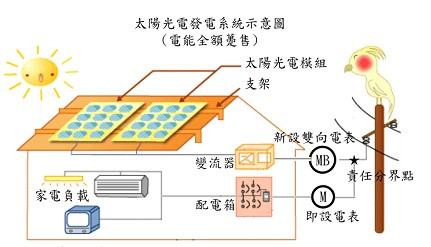
A : A solar power system that operates in conjunction with a power system and may transmit electricity to the power system is called an integrated solar power system (device). The point of integration of the output of an integrated system may be located on the inside of a household-owned line or on the outside of a TEPCO line, depending on the power application and barging requirements of the installer. The following diagram shows the output of a solar power system connected to an external line (all electricity produced is barged).
Q : What is the lifespan of a solar power generation system?
A : The solar power generation system consists of solar modules, DC wiring boxes (containing isolation switches and protection components), inverters (Inverter), AC distribution panels (containing AC circuit breakers and protection components) and other important components, which are installed through piping and wiring. The modules and inverters are two important system components whose quality, reliability or life span are crucial to the performance and lifetime of the system. The quality, reliability or lifetime of the modules and converters are related to the performance and life of the system. The use of certified modules and converters in the installation of solar power generation systems is a guarantee. Under normal use, the life span of a certified module is about 25 years or more, and the power output is still more than 80% of the initial capacity, while the life span of a certified converter is about 10 years or more.
Q : Will I have to pay a lot of tax if I sell electricity to Taipower?
A : The Ministry of Finance (MOF) explained on December 10, 2010 that natural persons with average monthly sales of less than NT$80,000 are exempted from business registration and business tax, and the electricity industry (Taipower) fills out a "Personal One-Time Trade Information Return" for natural persons at the time of payment. Take the 10KW system installed in Tainan as an example, only 6% (NT5,530) of the annual revenue of NT92,174 will be added to the individual's comprehensive income tax return.
Q : What happens if the house is sold after 20 years of contracting to sell electricity?
A : Solar systems are transferable, just like real estate, so if you need to sell your home, you can simply transfer the system to the next owner and continue to enjoy the income from the sale of electricity.
Q : Can I apply for building a farmhouse for solar power generation facilities?
A : As solar power generation facilities are not ancillary to farm buildings and agricultural facilities, applications for the construction of farm buildings on agricultural land should not be made after the installation of regenerative power generation facilities on the land.
Q : Do I need to apply for a licence to install solar power equipment?
A : According to Article 5 of the Standards for the Exemption of Miscellaneous Licenses for the Installation of Renewable Energy Facilities, solar PV systems may be exempt from a miscellaneous license under the Building Act if they meet one of the following conditions:
-
Installed on a rooftop or terrace, including support frames or a new canopy, with a height ≤ 4.5 m above the surface.
-
Installed on a rooftop projection, including support frames or a new canopy, with a height ≤ 1.5 m above the projection.
-
Installed on the ground with a height ≤ 4.5 m; or, if approved by the competent authority, including support frames or a new canopy, with a height ≤ 9 m.
Q:What unit should I contact to apply for a miscellaneous licence or exemption from a miscellaneous licence?
A :According to Article 18 and 19 of the "Local System Law" promulgated on 7 August 2024, construction management is a matter of local autonomy.
Q : What information should I submit if I am legally exempt from applying for a miscellaneous licence under the Building Code?
A :In accordance with Articles 7 and 8 of the "Standards for Exemption from Miscellaneous License Application for the Installation of Renewable Energy Facilities" announced on January 13, 2025, the following documents shall be submitted:
-
A copy of the approval and record-filing document for renewable energy generation equipment.
-
The Miscellaneous License Exemption Certification Form for Solar PV Systems (Appendix II), together with a cross-sectional schematic, site plan, and elevation view, all issued by a licensed architect, civil engineer, or structural engineer.
A structural calculation statement shall also be required if the system:
-
Has an installation height exceeding 3 meters;
-
Has a non-fixed tilt angle;
-
Extends beyond the centerline of the exterior wall or replacement column; or
-
Uses support racks combined with a new roof cover.
For transmission and transformation facilities with protective structures that meet the first or third condition above, a structural calculation statement is likewise required.
Upon completion, the following shall be filed with the local building authority: a structural safety certificate (Appendix III), a completion certificate (Appendix IV), and the required drawings (cross-section, site plan, and elevation view), all issued by a licensed architect, civil engineer, or structural engineer.
Q : If we want to conduct a carbon inventory, are there any recommended organizations or agencies? What are the approximate costs, conditions, and timeline
A :If your company requires a carbon inventory, Startrust Co., Ltd., co-invested by SPE & ASYS CORPORATION, can provide assistance. They have extensive experience in carbon inventory and sustainability data management, having supported over a hundred companies in completing inventories. Services are conducted in line with international standards such as ISO 14064.
Generally, the timeline is about 3 to 6 months, depending on the company’s scale and data completeness. Costs vary based on organizational size, complexity, and whether third-party verification is needed. We will work with Startrust to jointly assess your needs and provide the most suitable services with transparent cost planning, helping enterprises complete their carbon inventory smoothly and align with international trends.
Q : How do I buy carbon rights? How and at what price?
A : Three steps for companies to promote carbon management.
1. Carbon inventory and target setting (using SBT).
2. carbon reduction strategies, from energy saving and carbon reduction in production equipment and processes, to carbon reduction in the use or construction of renewable energy and power sources (using renewable energy).
We can assist you in the purchase of green electricity directly or in the procurement of renewable energy certificates.
We can assist with the matching of sites, the application and verification of renewable energy certificates, and the procedures for switching electricity supply.
3. Expanding the impact of carbon reduction: Expanding cooperation and gradually influencing the supply chain to reduce carbon emissions, etc.
◎ Method and price : As 99% of the green electricity certificates in the Taiwan market are bought by TSMC, there is a shortage of green electricity in the market and pre-orders are required to obtain them.
Therefore, you can sign a letter of intent or agreement with our franchised power sales company for the purchase of green electricity, and we will provide you with a solution according to your green electricity/certificate demand plan.
We will provide you with a solution based on your green electricity/certificate demand plan, e.g. if you wish to obtain 10% of your plant's electricity consumption by 2022, we will provide you with a plan based on your phased plan.
For example, if you wish to achieve 10% of your plant's electricity consumption by 2022, we will provide you with a plan based on your phased plan.
Q : What maintenance is required for the solar power system?
A : In addition to the warranty on the equipment itself, it is recommended that your installation contractor carries out an annual system check to ensure that all functions are functioning correctly. Solar panels usually do not require special maintenance. If it has not rained for a long time, a little rinsing can be done to prevent dirt from affecting the power generation performance.
Q : How do I clean my solar panels?
A : Solar systems are often installed with a sloping design, which allows for self-cleaning by removing dust, droppings, leaves and cobwebs from the solar panels through rainwater. In addition, it is recommended that the solar panels are cleaned every 1-2 months with water (high pressure water jets), a long pole mop and other tools, without the use of any chemicals.
Q: How can companies achieve carbon neutrality?
A:Green power can only offset the carbon emissions generated by your 'electricity use', but the complexity of a company's business and production activities and the emissions from other sources must be combined with negative carbon technologies and other policy tools to achieve carbon neutrality.
The business and production activities of your company are more complex than you think. There are three internationally recognised areas for calculating carbon emissions.
Area 1: Direct carbon emissions from factory production, from sources such as process gases, emergency generators, fuel used in public vehicles, or fugitive sources from other activities, including carbon dioxide (CO2), methane (CH4), nitrous oxide (N2O), hydrofluorocarbons (HFCs), perfluorocarbons (PFCs), sulphur hexafluoride (SF6) and nitrogen trifluoride (NF3). (NF3). The green electricity you buy doesn't offset this part of your carbon emissions.
Area 2: Indirect carbon emissions from purchased electricity, i.e. the electricity you buy from Taipower, the main greenhouse gas emission is carbon dioxide. By buying a green electricity voucher and using 100% green electricity in your factory, it means that you can claim 100% green electricity by buying the same amount of green electricity as you bought from Taipower, and offsetting the carbon emissions generated by your electricity use. If you think that using green electricity means zero carbon emissions, you may be using more electricity and producing more carbon emissions, which is not helpful to the environment.
Area 3: Other indirect carbon emissions, including supplier production and transport, waste disposal and staff commuting and travel.
Related Sources:Energy Administration
SunPower Energy currently offers a wide range of solutions for customers to choose from. Customers who opt for the Rental type will have all maintenance and servicing costs covered by SunPower Energy. For enquiries or to schedule an appointment, please call our service hotline 03-355-0137, and we will arrange for a specialist to visit your location and provide a detailed explanation.